


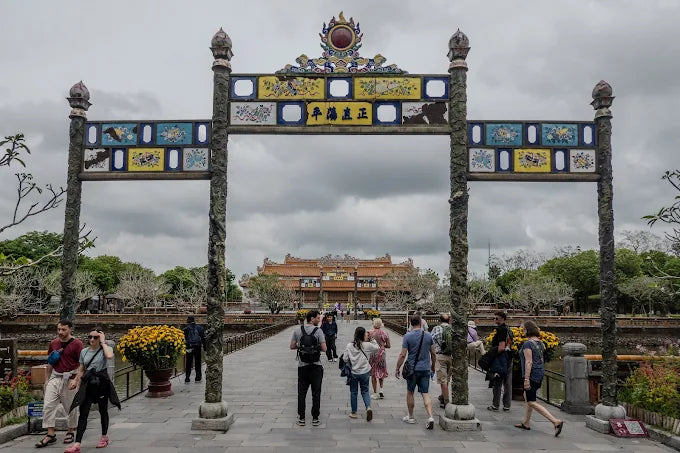
Thai Hoa Palace: The Heart of the Hue Imperial Citadel
Among the hundreds of structures in the Hue Imperial Citadel, Thai Hoa Palace is the most important, housing the throne of 13 Nguyễn Dynasty emperors. With its characteristic "trùng thiềm điệp ốc" (stacked roofs) architecture and exquisite carved details, it is not only a symbol of imperial power but also the pinnacle of Vietnamese court architecture. Join LocalTrips.ORG to step into this majestic space.
Geographical Location – The Center of Power
Thai Hoa Palace is located within the Imperial City, directly on the central axis of the Hue Imperial Capital. In front of the palace is the Great Rites Courtyard (Sân Đại Triều Nghi), where mandarins lined up during major ceremonies. Behind the palace is the Forbidden Purple City – the private living quarters of the emperor and the imperial family.
This location was chosen according to strict feng shui principles, placing Thai Hoa Palace in the most central position to affirm the emperor's supreme position within the dynasty.
List of Popular Places Near Thai Hoa Palace, Hue
Thai Hoa Palace was the highest center of power during the Nguyễn Dynasty, located directly on the central axis of the Hue Imperial City. As it is situated at the "heart" of the Imperial Citadel, from here you can easily visit a series of other important relics within just a few minutes' walk.
Below is a list of popular places near Thai Hoa Palace:
1. Southern Area (In front of the palace)
- Great Rites Courtyard (Sân Đại Triều Nghi): Located directly in front of the palace, this is where civil and military mandarins stood for grand court ceremonies. The courtyard is divided into two tiers with stone steles marking rank.
- Trung Dao Bridge & Thai Dich Lake: A charming bridge over a tranquil lake leading from Ngo Mon Gate to Thai Hoa Palace. Thai Dich Lake not only provides scenery but also holds feng shui significance for harmonizing vital energy.
- Ngo Mon Gate (Main Gate): About 100m south of Thai Hoa Palace. This is the largest and most beautiful gate of the Imperial City, where the emperor would review troops or conduct the New Year's Almanac distribution ceremony.
2. Northern Area (Behind the palace)
- Dai Cung Mon Gate: The main gate leading to the Forbidden Purple City, located directly behind Thai Hoa Palace.
- Can Chanh Palace: About 200m to the north. This was where the emperor worked daily and held regular court meetings (it was destroyed during the war and is currently being researched for restoration).
3. Western Area (Left wing from the palace)
- The To Mieu (The Mieu Temple): A temple dedicated to the Nguyễn emperors. This is one of the most massive and intact wooden architectural works.
- Nine Dynastic Urns: 9 colossal bronze urns placed in front of The Mieu Temple, symbolizing the dynasty's stability and the nation's wealth.
- Hien Lam Cac Pavilion: A commemorative pavilion honoring the contributions of meritorious officials, located opposite The Mieu Temple.
- Dien Tho Palace & Truong Sanh Palace: The living quarters of the Empress Dowager and Grand Empress Dowager, located further to the northwest.
4. Eastern Area (Right wing from the palace)
- Thai To Mieu (Thai Mieu Temple): A temple dedicated to the Nguyễn Lords, structured symmetrically with The Mieu Temple across the central axis.
- Duyet Thi Duong Royal Theater: The oldest continuously operating theater in Vietnam, located northeast of Thai Hoa Palace. This is where you can enjoy Hue royal court music.
- Hue Royal Antiquities Museum (Long An Palace): Located near Hien Nhon Gate (to the east), displaying thousands of rare artifacts from the Nguyễn Dynasty.
5. Architectural Highlights on Site
When at Thai Hoa Palace, don't forget to admire:
- The Emperor's Throne: Placed centrally, majestically painted red and gilded.
- Royal Canopy (Bửu tán): The system of exquisitely carved wooden ceilings above the throne.
- "Nhất thi nhất họa" decoration: Compartments on the eaves of the roof alternating between a painting and a Han Chinese poem.
An ideal itinerary usually starts from Ngo Mon Gate -> Thai Hoa Palace, then turns west to visit The Mieu Temple - Nine Dynastic Urns, then circles north to Dien Tho Palace and concludes in the eastern areas of the Imperial Citadel.
Unique Architecture – "Trùng Thiềm Điệp ốc"
Thai Hoa Palace was built in 1805 under Emperor Gia Long and completed in 1833 under Emperor Minh Mang. Unmissable features include:
- "Trùng thiềm điệp ốc" architecture: A system of overlapping roofs and interconnected chambers creates a sturdy, flowing structure, making the interior space immensely vast.
- System of ironwood columns: The palace is supported by 80 ironwood columns, painted red, gilded, and intricately carved with winding dragon figures.
- Emperor's Throne (Bửu tọa): Placed centrally in the main chamber, on a high platform, symbolizing the emperor's supreme position.
- Dazzling exterior: The palace roof is covered with yellow glazed tiles, adorned with dragon and phoenix figures made of colorful ceramic fragments, creating a splendid appearance under the sunlight.
[Image: Majestic Thai Hoa Palace with dazzling golden tiled roof system - Alt text: Architecture of Thai Hoa Palace, Hue Imperial Citadel]
Historical Witness – Where Grand Ceremonies Took Place
Thai Hoa Palace was the venue for the most important events of the dynasty:
- Grand Court Ceremony (Lễ Đại Triều): Held twice a month on the 1st and 15th days of the lunar calendar.
- Coronation Ceremony (Lễ Đăng Quang): The enthronement ceremony of the Nguyễn emperors.
- National ceremonies: Vạn Thọ ceremony, reception of foreign envoys, large-scale military reviews.
This is where the emperor's power was most clearly demonstrated through solemn and rigorous court rituals.
Admission Fees (Updated 2026)
Thai Hoa Palace is located within the Imperial Citadel, so you need to purchase an Imperial City ticket to visit this structure:
|
Ticket Type |
Category |
Ticket Price (VNĐ) |
|
Adult |
Visitors 12 years and older |
200,000 / entry |
|
Child |
Children 7-12 years old |
40,000 / entry |
|
Combo |
Combined with tombs |
420,000 - 530,000 |
Tips for Visiting Thai Hoa Palace from LocalTrips.ORG
- Attire: Please dress modestly when entering the palace (especially no overly short clothing).
- Photography: You can photograph the exterior grounds, but please pay attention to "no photography" signs inside (especially in the throne area) to protect the artifacts.
- Timing: It is best to go early in the morning to avoid crowds and intense heat. Consider hiring a local guide to hear fascinating untold stories of the court.
Q&A (FAQ)
1. Is it allowed to sit on the throne?
No, the throne is a national treasure and it is strictly forbidden to approach or sit on it in any form.
2. Is Thai Hoa Palace open on holidays?
Yes, the palace is open to visitors almost every day of the year, except for some days with special ceremonies (which will be announced in advance).
3. Why does the palace have so many wooden columns?
The system of 80 columns not only bears the weight of the massive roof but also serves to divide the space, create solemnity, and establish the hierarchy of mandarins' positions during court sessions.
Conclusion
Thai Hoa Palace is not just a beautiful architectural work; it is the embodiment of a distant dynasty whose powerful echoes still resonate through every stone and tile. Standing before Thai Hoa Palace, one feels as if touching a part of Vietnam's historical soul.
Are you ready to behold the Nguyễn Dynasty throne?
- [Contact LocalTrips.ORG to book a private guide for an Imperial Citadel tour]
- [Learn more about Hue's relics on LocalTrips.ORG]
- How did you feel when you first saw the throne? Please share!


Related collection
Explore collections containing this product


